
Beliefs Are Not Enough
On what I learned in 2012 as a new elementary principal
Hi, it’s Matt. This article is an update to a blog post I wrote in 2012. You can read the original here. Thank you for your leadership and readership!
In 2012, I was in my second year as an elementary principal. Like all job changes, I was still figuring out what I was supposed to be doing (this generally takes me three years).
Upon my arrival in 2011, the school had already embarked on a multi-year literacy initiative. The faculty was engaged in the Regie Routman in Residence: Reading-Writing Connection professional learning series, watching videos of highly effective instruction in action and applying these skills in classrooms.
Part of this learning experience was coming to agreement on what literacy beliefs we all could commit to; below are the eight we landed on after three years.
Our Beliefs
Shared writing text involving common experiences are often the easiest text to read.
The purpose of shared writing is not necessarily to focus on teaching conventions.
A child’s written story can be used to teach phonics and skills.
Shared writing is an excellent way to record common experiences and connect to reading.
Young children do not need to know all their letters and sounds before they can write stories and read back their writing.
Explaining vocabulary through interactive read-aloud can lead to students applying that vocabulary in their reading and writing.
A good way to work on a child’s reading is to help him/her become a strong writer.
Reading excellent literature and/or hearing excellent literature read aloud positively influences writing quality.
While we stated that these beliefs were important, I didn’t always see them play out in instruction. I would visit classrooms regularly during instructional walks and witness actions that contradicted them. For example, I rarely saw a child’s written story used to teach phonics and skills. Worksheets and isolated skill practice still proliferated in some classrooms. It wasn’t just teachers; I clicked the “approve” button on some purchase requests for resources like this.
My theory at the time was that we needed more effective ways to communicate these beliefs and hold each other accountable for their implementation. So, we invested in professional learning communities, or PLCs. I read Professional Learning Communities at Work by Rick DuFour and colleagues as part of my own studies.

One section in the resource touched on beliefs in a way that was different than what I had previously understood. The authors stated that beliefs alone were not enough. You also need values. The authors define values as core statements that clarify how a shared vision, or a list of beliefs, becomes a reality. It was made clear that as leaders, we need to focus on behaviors, not beliefs.
This created a conflict for me. Do I focus on behaviors or beliefs? Who was right: Regie or Rick?
I found my answer at a literacy institute hosted by Regie and colleagues. Judy Wallis, a literacy consultant, explained that beliefs and values are part of a continuum for a school in change.
“Schools can develop their shared beliefs first. These are the principles that you would be willing to fall on your sword for. An example: ‘We believe students should have wide access to books they can and want to read.’ Would any educator worth their salt disagree with this belief?”
Once beliefs are established, schools can examine their values. Judy defined values as our instructional practices, our beliefs in action. Rereading the belief that students should have access to books they can and want to read, a corresponding value could be: "Independent reading happens in every classroom, every day, with the appropriate amount of support."
You cannot have beliefs without values, and vice versa. Beliefs provide the common language that drives the implementation of common practices. Our values are a mirror for our beliefs. What we see in practice tells us what we actually believe, not just what we say we believe.
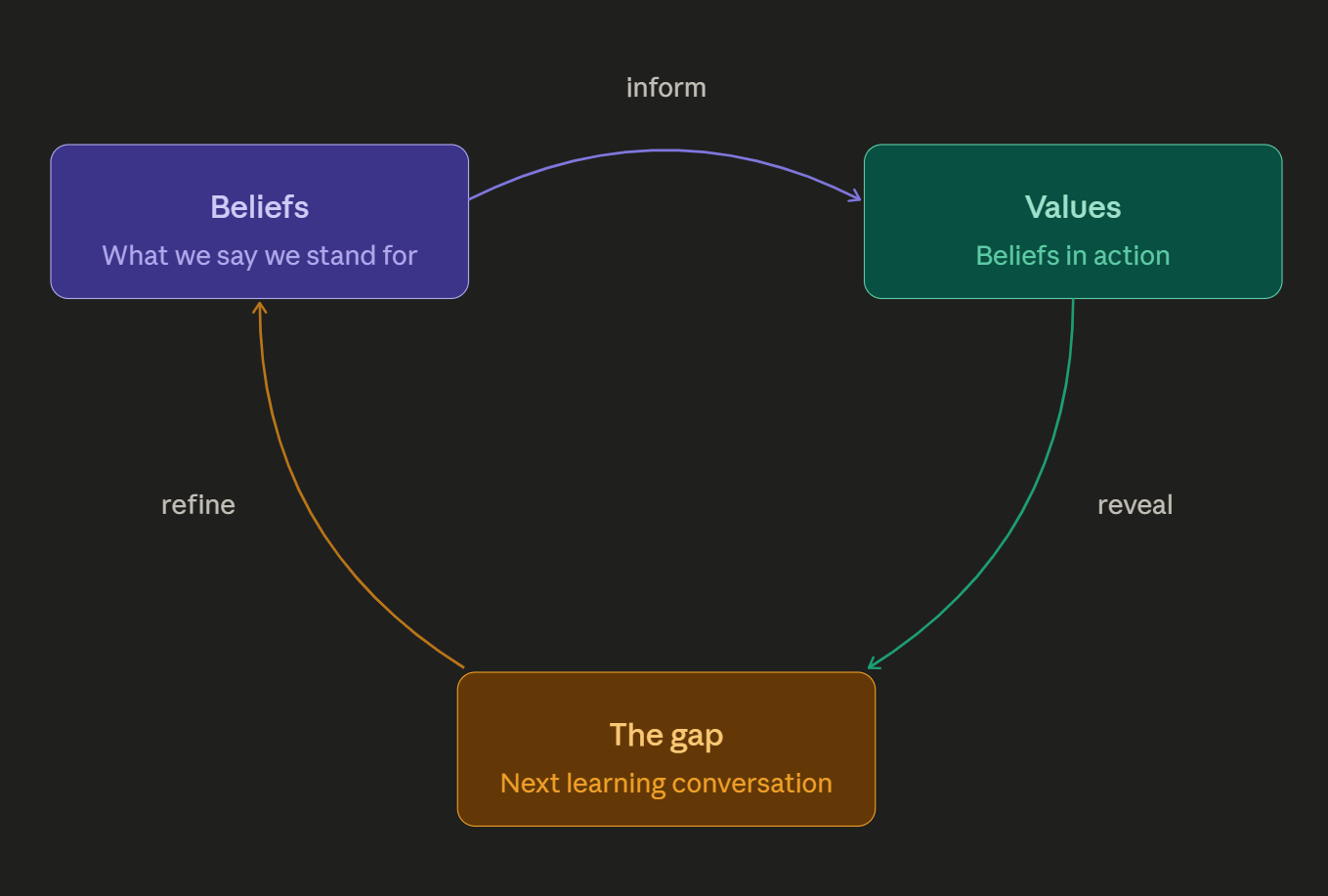
This foundation of beliefs and values inoculates schools from relying too heavily on programs and resources. It cannot be bought, only built.
In your school, where do you find your beliefs and values aligned? Where is there a deviation, and how are you working to close that gap?
Enjoyed this post? Share it with a colleague and online.