
Five Prerequisites for Continuous Improvement
On building and stabilizing systems to support professional learning
👋 Hi, it’s Matt. Thanks for being a reader. I write about literacy and leadership, including my free guide, What School Leaders Need to Know About the Science of Reading. Last week, I published my conversation with Dr. Kelly Cartwright. This week, I write about what’s needed for schools to engage in continuous improvement. At the end is a link to a free one-page leadership team guide that complements this post.
What’s the problem your school has been working on this year? How do you know it’s actually a problem? What’s the evidence? Whose voices were invited to name and shape it? Whose voices weren’t?
If you answered I don’t know to any of those questions, you likely haven’t yet identified the actual problem you’re trying to solve. That’s not a judgment. In my experience working with school leadership teams, the presenting problem and the real problem are often meaningfully different.
That gap is what this article is about.
Three stages before improvement work takes hold
For school leadership teams to engage in continuous improvement — using tools like root cause analysis, driver diagrams, and PDSA cycles — they first need to reach a level of stability and shared understanding. In my experience working with teams, that readiness tends to develop across three stages.
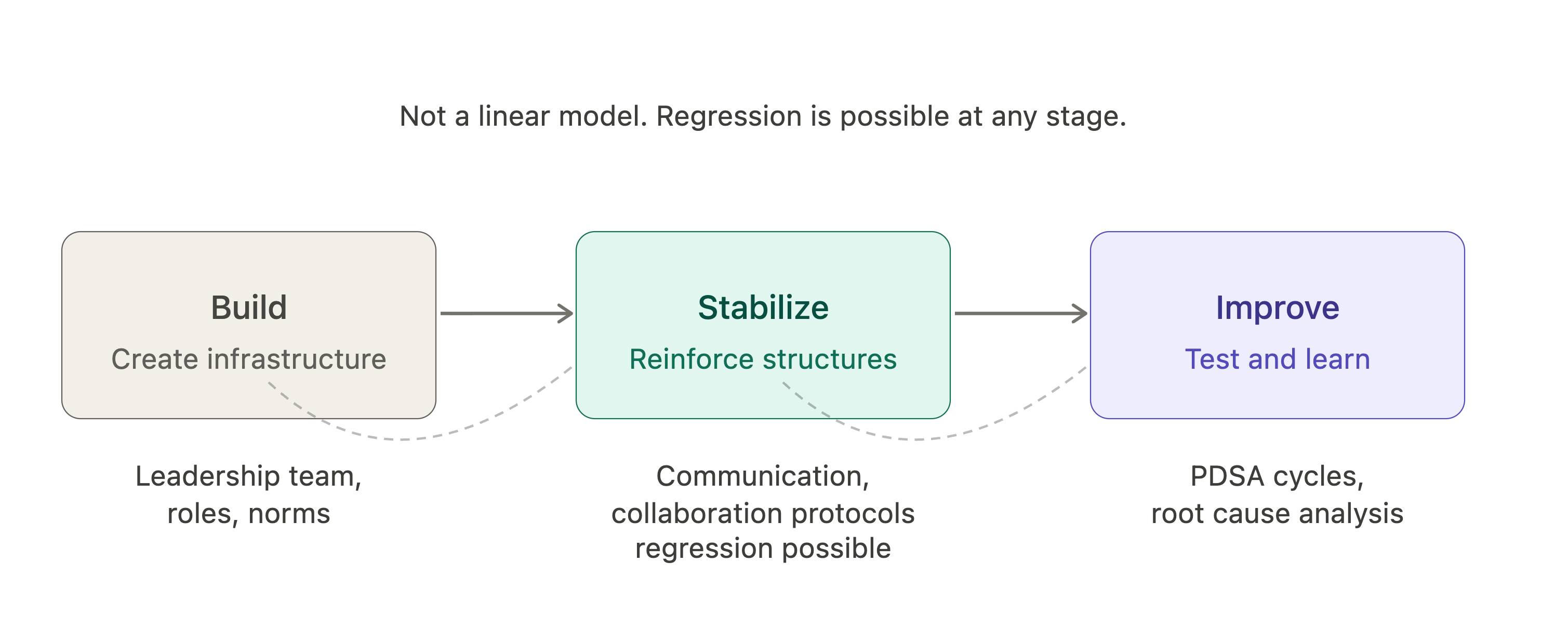
In the build stage, leaders are asking for structures. They need a basic organizational framework to make sense of their current reality and hold different processes and initiatives together.
In the stabilize stage, those structures get reinforced. The leadership team develops shared agendas and communication routines. Grade-level and department teams start receiving clearer direction. Protocols for collaboration begin to take shape. One hand starts talking to the other.
Once infrastructure is built and stabilized, teams are ready to engage in improvement work: using data to test changes and learn from what happens.
This is not a linear model. A school with high leadership turnover may need to return to the build or stabilize stage before improvement work can take hold again, unless the previous team reached a level of sustainability deep enough to survive the transition.
In addition to these stages are five building blocks, or prerequisites, I see as essential conditions for supporting and sustaining continuous improvement.
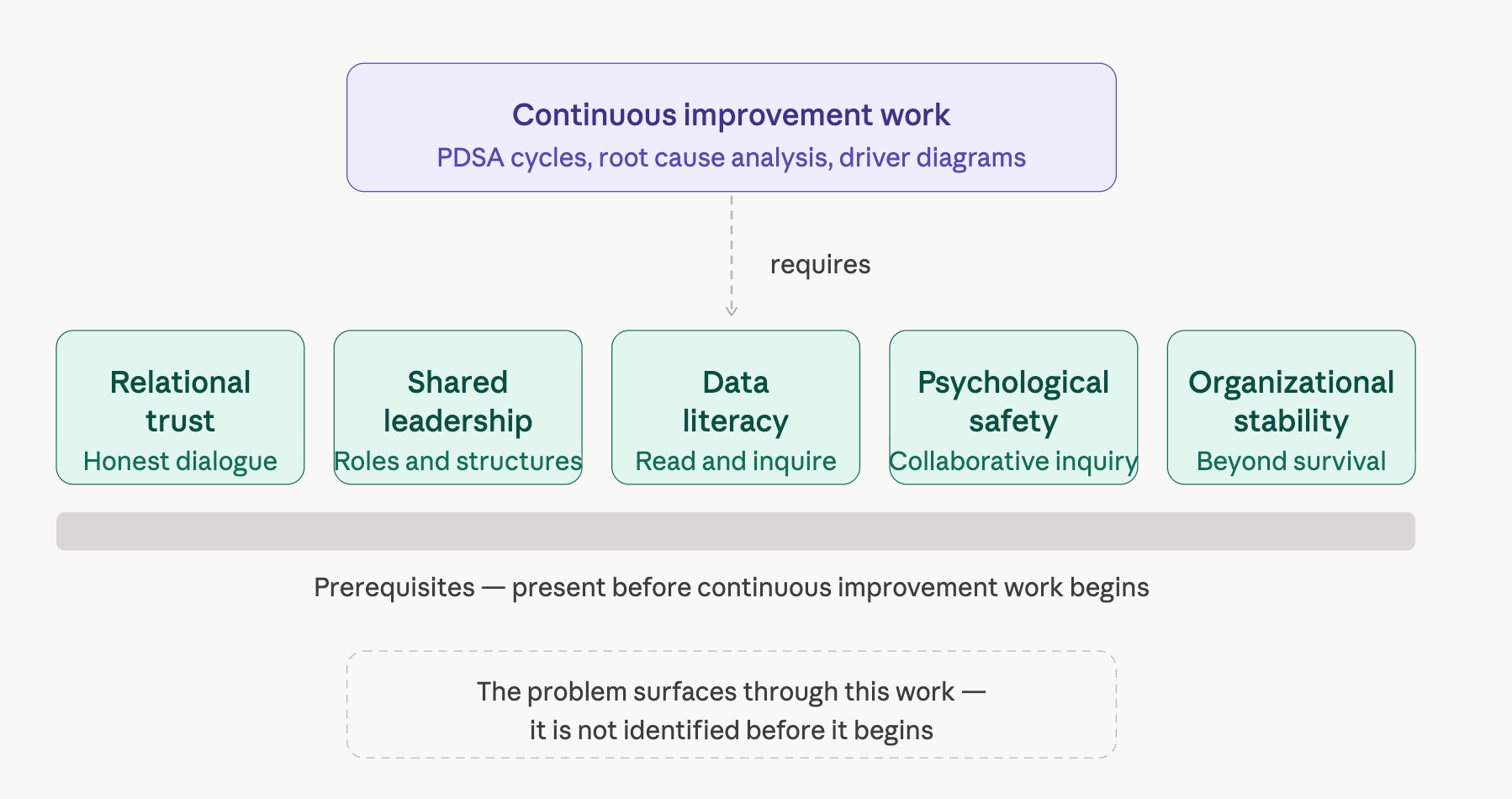
Here are the five prerequisites in more detail.
1. Relational trust
This may be the most critical condition of all. Relational trust is present when educators can engage in open, honest dialogue without fear of negative reactions or damaged relationships. It shows up in how people talk to each other in meetings, how positional leaders respond to disagreement, and whether feedback flows in both directions.
Trust is built through clear norms, consistent follow-through, and frequent informal positive interaction. A ratio of roughly five positive interactions to every critical one is a good baseline for healthy professional relationships.
Positional leaders set the tone. When a principal openly asks for feedback about their own practice and responds with curiosity rather than defensiveness, it signals to the entire building that honest dialogue is safe here.
Bryk and Schneider’s Trust in Schools includes a practical survey for measuring relational trust at the building level. As a principal, I used it every year. It consistently showed me where I had room to grow and where the staff had real strengths to build on. (You can find the nine survey items in Devin Vodicka’s article The Four Elements of Trust.)
2. Shared leadership structures
One priority for better school support is helping bring together a functional leadership team. This typically includes a mix of positional and informal leaders: a principal, a coach, a specialist, and a handful of teachers. Keeping the team to eight or fewer members helps ensure everyone stays focused and the work gets done.
Within that team, clearly defined roles and responsibilities matter. One shift I’ve made in my own coaching is to assign someone else besides the principal as the team lead. I learned this the hard way. When I was a principal, I consistently led our leadership team discussions rather than empowering my instructional coach to take that role. When I had to be away from the building for a stretch, she stepped up and led the team beautifully, and eventually became a principal herself. My only regret is that I didn’t give her that opportunity sooner.
Beyond roles, communication processes need to be transparent and consistent. Agendas and minutes shared in a timely manner, with open invitations for feedback, signal that the leadership team’s work belongs to the whole building and not just the people in the room. As a principal, our leadership team meetings were open for anyone to observe and comment on, even if decision-making authority stayed with the team.
Clarity about who makes what decisions, and under what conditions, is essential. Some decisions rest with the administrator. Hiring, for example, ultimately belongs to the principal. Others, like a curriculum acquisition process, warrant full leadership team involvement. When those boundaries are unclear, trust erodes quickly.
3. Data literacy
It’s difficult to engage in continuous improvement if you’re not sure where you actually are. We can’t improve on nothing, but we also shouldn’t rely solely on standardized test scores to tell us what’s happening in our schools.
Data literacy means understanding different levels and types of data, and how they can work together to build a fuller picture. Safir and Dugan offer a helpful model in Street Data: satellite data, which captures systems-level measures like state assessments; map data, which includes screeners and common formative assessments used at the team level; and street data, the qualitative, real-time information that teachers and coaches gather directly from students.
Each level has strengths and limitations. Quantitative data offers a sense of certainty, but without context, it can flatten your understanding of what’s actually happening in a school. Qualitative data — empathy interviews, student surveys, classroom observations — tells the story behind the numbers. The two work best together.
As a principal, I made daily classroom visits and recorded what I observed in handwritten notes, describing the teaching and learning experience as specifically as I could. I’d share those notes with the teacher afterward, and we’d have a conversation around what I noticed. What struck me over time was how often those conversations led to genuine insight. Because we were both looking at the same descriptive data together, the dynamic shifted. We weren’t talking about performance or growth targets. We were inquiring together. The data gave us something to be curious about rather than defensive around.
Data literacy starts with the leadership team. When leaders model how to read and discuss data honestly, sitting with uncertainty and asking questions before drawing conclusions, that practice begins to spread into staff meetings and collaborative team time.
4. Psychological safety for collaborative inquiry
When relational trust is present, leadership structures are functioning, and the team has a basic understanding of data, something else becomes possible: genuine collaborative inquiry. But this doesn’t happen automatically. It has to be taught, modeled, and practiced before it becomes cultural.
A useful starting point is naming what collaboration is and what it isn’t. The Solution Tree literature around professional learning communities offers helpful frameworks for understanding the stages teams move through as they develop collective practice.
It also helps to make collaboration visible. A fishbowl demonstration at a staff meeting, where one team models their dialogue while others observe, gives educators a concrete picture to work toward. Educators can also be invited to observe a colleague team’s session, with a clear shared focus to keep the feedback productive rather than evaluative.
What I’ve found most effective is creating conditions where educators are doing inquiry work without initially labeling it as such. For example, I shared a profile/inventory with teachers for students with ADHD. They will first reflect on their own instructional environment and practices. Then they will ask the student for their perceptions of these same conditions. When we come together as a group to look at both sets of responses, teachers can offer and receive feedback, drawing on data and problem-solving together. These are the seeds of root cause analysis and PDSA thinking, planted quietly in the middle of work they already care about.
5. Organizational stability
Right now in Wisconsin, school districts are either celebrating a referendum that passed or absorbing the weight of one that didn’t. For those in the latter situation, and there are too many due to inadequate support from state legislators, asking them to engage in continuous improvement work may feel tone-deaf. What they need first might simply be acknowledgment and a genuine offer of support, whatever form that takes.
That said, if an entry point presents itself, for example, if a principal or coach says we still have to do this work because it matters for kids, there may be room for a small, contained inquiry cycle. One possibility: examining family and community engagement, and how the school might build stronger partnerships with parents and community members who need to see the good work their tax dollars are supporting. It’s outward-facing work that can generate goodwill while the harder internal work waits for steadier ground.
Improvement work requires sufficient organizational stability for people to think beyond immediate survival. When that stability is absent, the coaching move is to stay close, stay humble, and wait for the opening.1
Enjoyed this article? Share it on social media and with your colleagues.
Full subscribers can extend upon the ideas shared here in the comments.
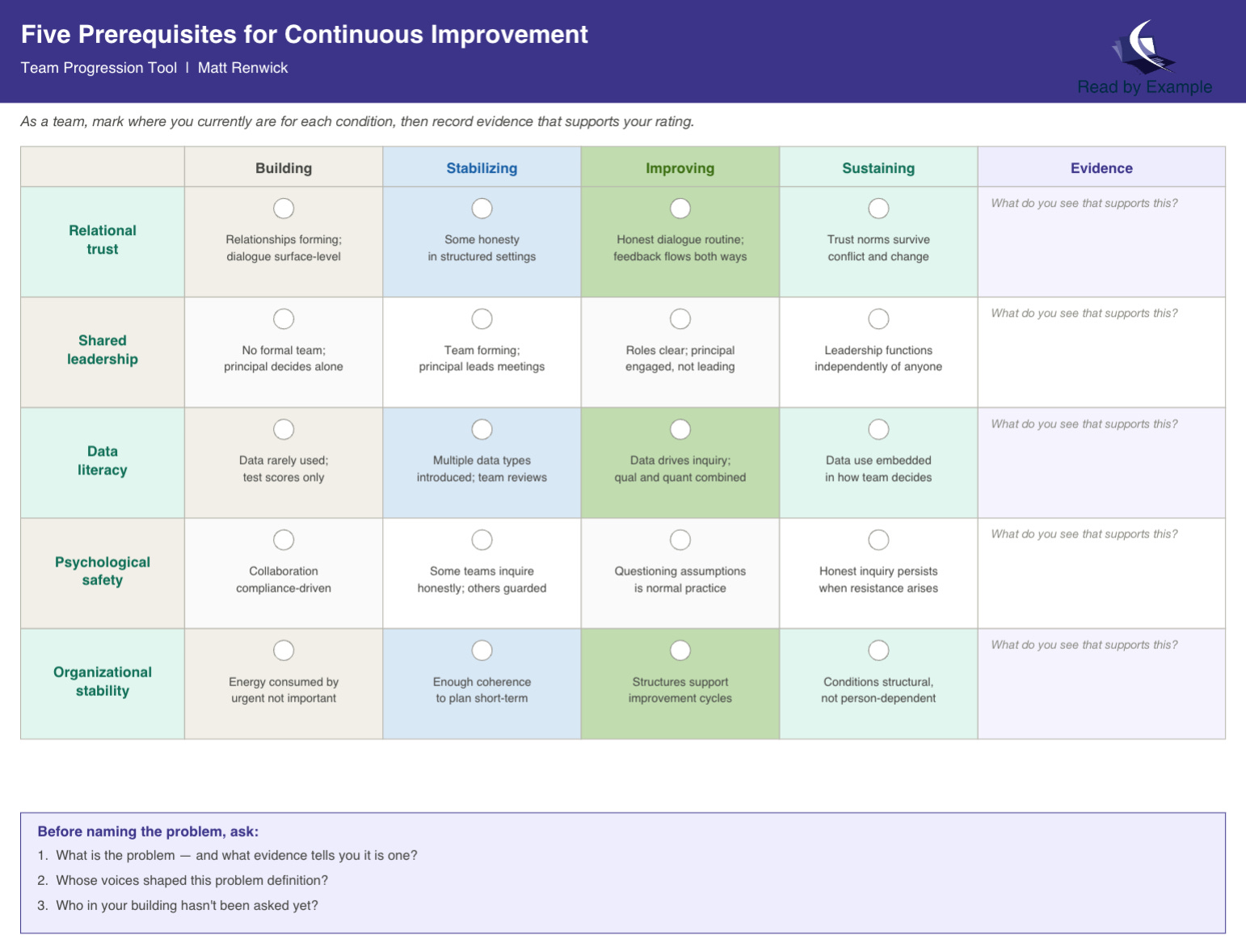
Try it: Assess Your Organization’s Infrastructure
Download the one-page team progression tool below (or here). It supports a leadership team to examine their current reality and discuss potential areas for growth.2
Audio transcripts for this article were cleaned up and edited with the assistance of Claude (Anthropic).
When you download this tool, you will be offered an opportunity to sign up for a two-hour coaching session with me. I am available to help school leadership teams in this process.