
Natural Consequences
On creating the conditions for students to become readers and writers
👋 Hi, it’s Matt. I write a weekly about literacy and leadership. Last week, I wrote about what actual science looks like in reading instruction. This week, I reflect on the consequences of centering literacy instruction on programs and testing instead of on students. Subscribe today to receive all posts!
My daughter texted me the following photo.
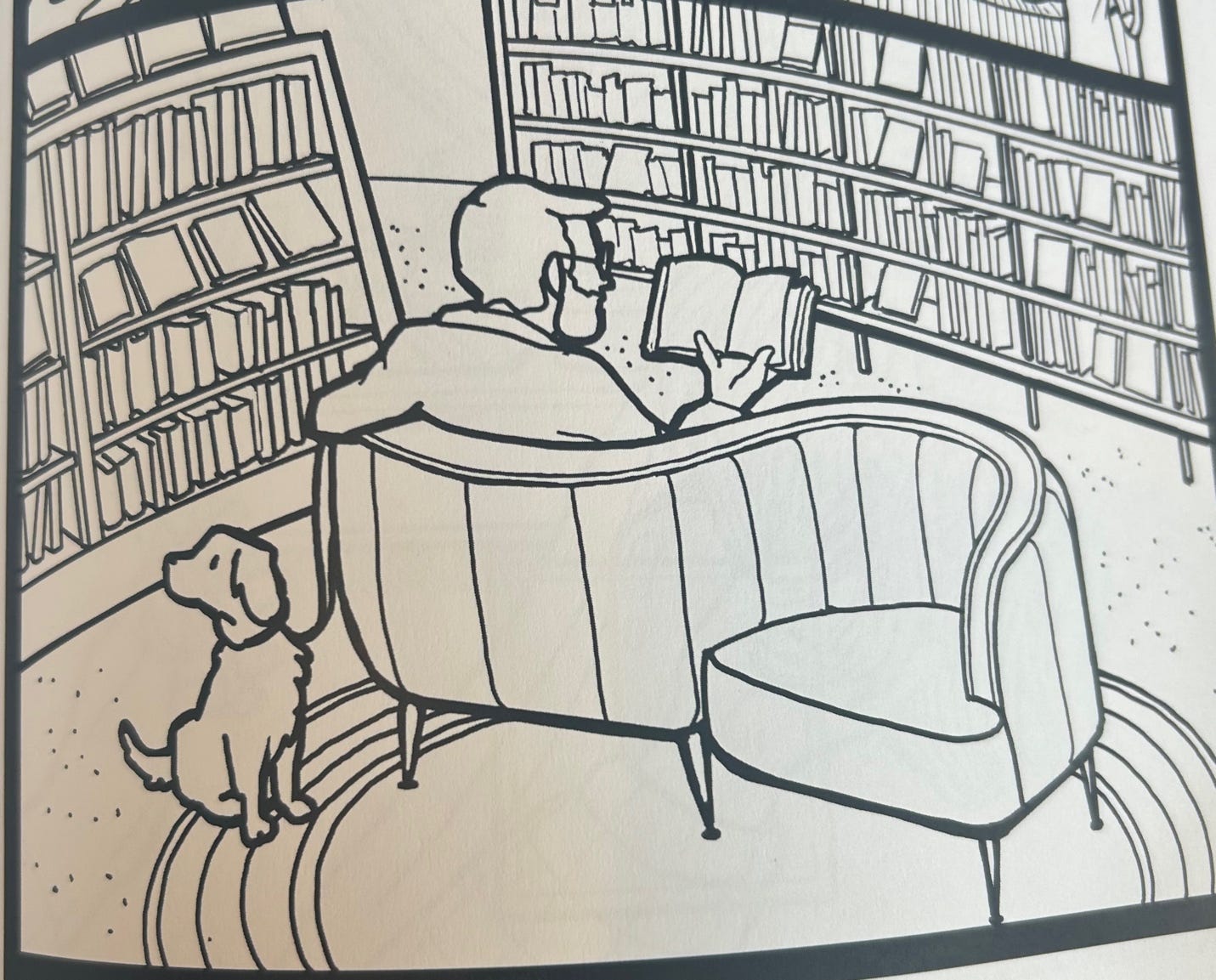
“Uhh…is that Millie and me?” I asked.
“Yup!” she replied.
The image is a picture she took from a coloring book created by a local artist. She illustrated various sites and businesses in our small city, including the independent bookstore I work in on Sundays. Our English cream golden retriever, Millie, is my assistant.
While we couldn’t confirm if the depiction is in fact the dog and me, you can find me in that position on a Sunday afternoon. (My wife can’t believe I get paid to do this work.)
It would be interesting to contrast this image with what one might observe in a typical K-12 classroom. Would we see something similar: students reading quietly in comfortable seating?
My own experience in visiting schools tells me this is uncommon. Even though we know that one of the best ways to get better at reading is to read, we have overstuffed our school days with literacy programs and reading-like activities. Hitting standards has become more important than hitting the books. Therapy dogs might be more common in schools than a robust classroom library.
So, it should come as no surprise that reading achievement scores continue to stagnate as a nation. These results run parallel to how students feel about reading in general. The typical student doesn’t see reading as a worthwhile activity. Although there are other factors contributing to this decline, including increased screen time and so many other opportunities pulling at kids’ attention, there appears to be a strong relationship between achievement and engagement.
I feel at a loss when schools want to improve their reading outcomes and don’t first look at their own instructional decisions before going on a hunt for a new program. The word “book” is rarely mentioned in these exchanges. I imagine a lot of educators feel similar frustration for what to do. They sense the pressure to improve test scores, so they lean in heavily on a program and teach it to “fidelity”. But in their commitment to a curriculum, they are also creating inequities. A foundation of effective instruction is a teacher’s ability to meet the individual needs of students. We cannot please two masters.
To be clear, I am not anti-program. As a principal, I helped lead a curriculum acquisition process for our school that led to the purchase of a program. However, we were clear that this was a resource to support excellent instruction, not the source for it. Positioned this way, a program can augment teaching and learning. But not the other way around.
The one thing K-12 schools have that no one else does is the ability to center students’ attention on what society seems to crave right now: a distraction-free space to read and talk about ideas that matter to them. Independent bookstores are thriving for the same reason; people want a third space to be with others in relation to each other, not just at a surface level. Schools can be that.
If we take a step back and look at the issue at hand – lack of time to read, too much teaching and not enough access to books – we shouldn’t be surprised that our students are not growing as readers. Decreasing engagement and achievement is a natural consequence when we don’t create the conditions that target these needs. Again, these two areas are highly correlated.
My intention here is not to blame or to wallow. It’s to develop awareness, as well as a pathway to creating the conditions where students value reading and identify as readers.
If I were back in the classroom, here’s what I imagine my instruction would look like to a visitor:
The room feels lived in. It has the students’ thumbprints all over it: the classroom libraries are organized and curated by the kids, student work takes up most of bulletin board real estate, and anchor charts for effective ledes or how to deliver a book blessing adorn the walls. Learning targets and success criteria include samples of the tasks co-created with the students during shared demonstrations.
If the visits were frequent, odds are you would not actually see me teaching to a whole group; students would be found reading or writing independently and in small peer groups. I would be meeting with students as needed, informed by multiple data points. Students are on task not because I drilled the expectations, but primarily because they want to be doing the work. They often have choice and agency in what to read or write. When the core resource is used, it’s a true resource: a guide on the side to support their journey to independence and excellence, for example, students walking out of the classroom with their nose in a book, not wanting to stop reading at the end of the day.
The natural consequences of these conditions aren’t something you can buy. It’s a product of an investment in teacher quality and respect for educators as professionals.
How are you centering your students in your instructional design, despite the possible constraints of mandates and testing?
Did you enjoy this post? Share it with a colleague!
Congratulations Matt on another terrific post! Love the intro and image with your dog and you (or a reader) in the independent bookstore you work in on Sundays, a reminder that reading involves, books, first and foremost. Thoughtful alternatives to teaching centered on mandates and testing.