
What I’m Reading: 2025
My reading list from 2025, along with a review of my favorite books plus commentary
Harry Potter and the Deathly Hallows, J.K. Rowling (Fantasy/Young Adult)
After: A Doctor Explores What Near-Death Experiences Reveal about Life and Beyond, Bruce Greyson (Science/Spirituality)
The Book of Joy: Lasting Happiness in a Changing World, His Holiness The Dalai Lama & Archbishop Desmond Tutu (Philosophy/Spirituality)
Coaching for Equity: Conversations That Change Practice, Elena Aguilar (Education/Coaching)
A System for Writing: How an Unconventional Approach to Note-Making Can Help You Capture Ideas, Think Wildly, and Write Constantly, Bob Doto (Productivity/Writing)
The God of the Woods, Liz Moore (Literary Fiction/Mystery)
Essayism, Brian Dillon (Literary Criticism/Essays)
Dead of Winter, Darcy Coates (Thriller)
How to Take Smart Notes, Sönke Ahrens (Productivity/Writing)
The Serviceberry: Abundance and Reciprocity in the Natural World, Robin Wall Kimmerer (Nature Writing/Philosophy)
Fear: Essential Wisdom for Getting Through the Storm, Thich Nhat Hanh (Philosophy/Spirituality)
The Need, Helen Phillips (Literary Fiction/Science Fiction)
Biased: Uncovering the Hidden Prejudice That Shapes What We See, Think, and Do, Jennifer L. Eberhardt (Psychology/Social Science)
Dinner for Vampires: Life on a Cult TV Show, Bethany Joy Lenz (Memoir)
Resonate: Present Visual Stories that Transform Audiences, Nancy Duarte (Business/Communication)
The Craving Mind: From Cigarettes to Smartphones to Love--Why We Get Hooked and How We Can Break Bad Habits, Judson Brewer (Psychology/Neuroscience)
What Art Does: An Unfinished Theory, Brian Eno (Art Theory/Philosophy)
Managing Transitions: Making the Most of Change, William Bridges (Business/Self-Help)
The Recovering: Intoxication and Its Aftermath, Leslie Jamison (Memoir/Addiction)
Greatest Hits, Harlan Ellison (Science Fiction/Short Stories)
Arise: The Art of Transformational Coaching, Elena Aguilar (Education/Coaching)
Mapping the Interior, Stephen Graham Jones (Horror)
ADHD 2.0: New Science and Essential Strategies for Thriving with Distraction—From Childhood Through Adulthood, Edward M. Hallowell (Psychology/Self-Help)
Original Sins: The (Mis)education of Black and Native Children and the Construction of American Racism, Eve L. Ewing (Education/History)
The Laws of Simplicity, John Maeda (Design/Philosophy)
The Artist’s Way: A Spiritual Path to Higher Creativity, Julia Cameron (Self-Help/Creativity)
Civil Discourse: Classroom Conversations for Stronger Communities, Joe Schmidt & Nichelle Pinkney (Education/Pedagogy)
The Ministry for the Future, Kim Stanley Robinson (Climate Fiction/Science Fiction)
Another, Paul Tremblay (Middle Grade/Horror)
The Last House on Needless Street, Catriona Ward (Horror/Thriller)
Crucial Influence, Third Edition: Leadership Skills to Create Lasting Behavior Change, Joseph Grenny, Kerry Patterson, David Maxfield, Ron McMillan, & Al Switzler (Business/Leadership)
The House in the Cerulean Sea, T.J. Klune (Fantasy/Romance)
Misery, Stephen King (Horror/Thriller)
Small Spaces, Katherine Arden (Middle Grade Horror)
The Pumpkin Princess and the Forever Night, Steven Banbury (Children’s Fiction/Fantasy)
Empire of AI: Dreams and Nightmares in Sam Altman’s OpenAI, Karen Hao (Technology/Journalism)
A Brief History of Equality, Thomas Piketty (Economics/History)
The Bone Clocks, David Mitchell (Literary Fiction/Fantasy)
Catching the Big Fish: Meditation, Consciousness, and Creativity, David Lynch (Creative Nonfiction/Philosophy)
Dr. Jekyll and Mr. Hyde, Robert Louis Stevenson (Classic Fiction/Horror)
The Manse, Lisa W. Cantrell (Horror)
The Anxious Generation: How the Great Rewiring of Childhood Is Causing an Epidemic of Mental Illness, Jonathan Haidt (Psychology/Social Science)
Controversy in the Classroom, Diana E. Hess (Education/Pedagogy)
Mapping Leadership: The Tasks that Matter for Improving Teaching and Learning in Schools, Richard Halverson & Carolyn Kelley (Education/Leadership)
The Final Girl Support Group, Grady Hendrix (Horror/Thriller)
Small Things Like These, Claire Keegan (Literary Fiction)
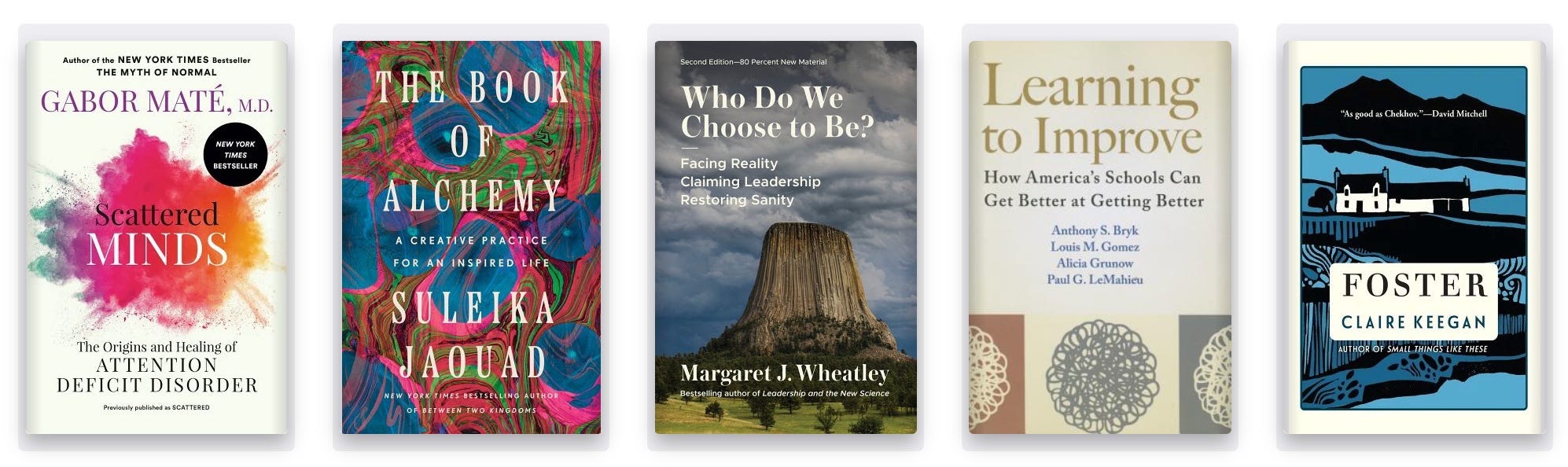
Learning to Improve: How America’s Schools Can Get Better at Getting Better, Anthony S. Bryk, Louis M. Gomez, Alicia Grunow, & Paul G. LeMahieu (Education/Professional Development)
Syllabus: Notes From an Accidental Professor, Lynda Barry (Creative Nonfiction/Education)
Who Do We Choose To Be?: Facing Reality, Claiming Leadership, Restoring Sanity, Margaret J. Wheatley (Leadership/Philosophy)
Foster, Claire Keegan (Literary Fiction)
The Book of Alchemy: A Creative Practice for an Inspired Life, Suleika Jaouad (Creative Nonfiction/Self-Help)
Scattered Minds: The Origins and Healing of Attention Deficit Disorder, Gabor Maté (Psychology/Memoir)
Notable Books I Read in 2025
Foster by Claire Keegan
A pitch-perfect of a novella, spare in description to allow the dialogue and action to tell the story. Much is left unsaid, but inferable by the reader. A study in both trauma and resilience, both made possible by family and relationships for better and for worse.
My friend and colleague, Regie Routman, recommended this book along with Keegan’s equally excellent Small Things Like These in her regular reading reviews. Here is what she had to share about Foster, from her March 2023 review:
“It’s one of those exquisitely written stories that is unputdownable. Set in rural Ireland, a young girl is brought by her father to spend the summer with a childless couple, her mother’s relatives, presumably because the young girl’s family is overwhelmed by their large, growing family. As the story unfolds, narrated ‘with precise insight’ by the young girl, we can’t help but empathize with the moments of affection, heartbreak and grief that permeate this story. This remarkable book has stayed with me months after I finished reading it.”
(This summary of what I am reading is modeled on Regie’s own invaluable review; find all of them here, along with a searchable archive in the right side margin.)
Who Do We Choose To Be?: Facing Reality, Claiming Leadership, Restoring Sanity by Margaret J. Wheatley
This is a hard book to comment on...Wheatley offers both a stark assessment of our current society and a clear-eyed path forward.
Her study of civilizations and collapse can be anxiety-inducing. But Wheatley embraces this as a paradox: things are always changing, so it does little to try and hold onto what is impermanent. Going beyond hope, we can focus on what’s in front of us and do our best to make the best of it.
I was given a copy of this book from a colleague. In the margins on one page, he wrote: “More data does not help us make better decisions.” As leaders, we have a tendency to accumulate lots of information as an act of admiring problems. What if we gave as much credibility to our intuition as the numbers? A mindset I am trying to embrace in my own work supporting leaders.
Learning to Improve: How America’s Schools Can Get Better at Getting Better by Anthony S. Bryk, Louis M. Gomez, Alicia Grunow, & Paul G. LeMahieu
A comprehensive and practical approach to facilitating improvement in schools. The tools Bryk and colleagues recommend - fishbone/root cause analysis, PDSAs - are not new to anyone familiar with improvement science. But the way the authors organize this process, and make the case for why, is compelling.
There are also several pithy phrases that I am trying to commit to memory. A favorite: practice-based evidence (a practitioner’s response to the often referenced “evidence-based practice”).
The gift this resource brings to K-12 teachers and leaders is agency and self-efficacy. Using a few fairly simple tools in a systematic way does seem to offer any group of educators a pathway to schoolwide excellence.
The Book of Alchemy: A Creative Practice for an Inspired Life by Suleika Jaouad
For the 100th essay/journal prompt, the writer invited me to do something artistic, nothing major. I initially resisted this invitation, which told me I should probably do it. I made a small airplane out of the slip of paper I was using as my bookmark. It didn’t look awesome and flew even more poorly.
Instead of dwelling on the negative, I paid attention to this disappointment and got curious about its source. Likely, it was a desire to be good, to be seen as competent and not judged. How silly, given that no one was around me at the table where I did all my reflective writing supported by this book.
This is how journaling can be productive: it helps you to rethink what you’ve always thought and question unhelpful stories you have created based on one’s biases and fears. The Book of Alchemy was properly organized by themes and sequenced in almost a therapeutic way, starting by building trust in ourselves to simply put words down on paper. Over time, the structure of this guide helped me arrive at important insights about what might be holding me back.
One insight I have developed is a need for some type of hobby beyond my work in education. My profession is rewarding but can become all-consuming, a vocation that crowds out the other joys of life. I’m now thinking about fly fishing, and making flys (flies?). I live in the Driftless region of Wisconsin, within driving distance of many trout streams. I enjoy being in nature, but can get bored with simply hiking or watching a tip-up on a frozen pond.
If you are feeling stuck with your journaling, or with life in general, I recommend Jaouad’s guide to self-discovery and the creation of a more rewarding and interesting life.
Scattered Minds: The Origins and Healing of Attention Deficit Disorder by Gabor Maté
I have avoided reading this book even before I learned that I have ADHD. How someone else framed the author’s POV is “anti-medication” and that this diagnosis doesn’t exist. Having worked for a number of years with students and family members who struggle with ADHD, and seeing some of the benefits stimulants brought along with the research to support them, I feared this book would be a one-sided critique.
I finally picked it up when a friend noted that this book helped their spouse understand their own ADHD and accept it. I’m glad I read it. Maté has written a resource that is uncommon in the self-help/medical literature: as much a memoir as a guide for navigating this issue. The author speaks from personal experience, sharing his story with humility and honesty. These narratives are interwoven with what was known at the time about this diagnosis (which Maté reframes as “attunement developmental disorder”).
The author isn’t anti-medication or any other treatment; he is pro-unpacking the deeper issues as to why one experiences ADHD and how to address whatever trauma and experiences might have contributed to our current challenges. I can attest to the benefits of a holistic approach to healing and support.
Commentary: No Secrets, No Shame
Several books I read this year for a graduate course kept circling back to the same question: What conditions allow educators to grow professionally? The throughline of the books I read—including Learning to Improve—is the importance of communication and collaboration to build the capacity of educators to make a positive impact on student learning.
I framed a high leverage solution as “collective agency through collaborative inquiry”. Maybe a bit jargon-y and vague. But I don’t love the term “collective efficacy”; it’s used a lot in education, and not always defined clearly. Agency through genuine empowerment and shared inquiry feels more appropriate and generalizable across contexts.
A school starts becoming more functional when it makes the invisible structures and resulting student data that result from transparent, open to critique and change. When the work gets to this stage, leadership teams often hit pause and stop the improvement process. Why? Some of it is time and resources. Their days are hectic, and this type of work requires one to pause, study, and reflect.
Another, more deeper reason is relational trust; people don’t feel safe enough in a community to be vulnerable and admit to what they don’t know.
As I think about this dilemma, I come back to a line in Claire Keegan’s Foster, a quote that gave me pause:
‘Where there’s a secret,’ she says, ‘there’s shame—and shame is something we can do without.’
I think shame is a major barrier to school improvement. Teachers and leaders feel it when students aren’t successful and worry that past practices have influenced these results. How do we help educators process these emotions and use them productively?
That’s where I see Learning to Improve’s recommendation of Networked Improvement Communities (NICs) as a novel solution. They go beyond PLCs because they organize learning systematically across schools and districts. In rural areas, teaching and leading can be isolating—many districts have only one or two sections per grade level, or a department of one at the secondary level. A NIC can be a lifeline.
As Bryk and colleagues note: “today’s problems cannot be solved through isolated individual actions... we can accomplish more together than even the best of us can accomplish alone.”
When solving shared problems together within a supportive community, educators aren’t working in isolation where secrets and shame fester. These are the conditions that allow professionals to grow: transparency without judgment, collective inquiry over isolation, and agency built through collaboration rather than compliance.