
Hi, it’s Matt. Thank you for your readership and leadership. If you haven’t already, please provide feedback on Read by Example here. Your insights are appreciated!
“Every student is not the same, nor is every context. The complexity of teaching and learning is real, and it cannot be side-stepped by standardizing all activity in an effort to ‘teacher-proof’ instructional environments.”
— Anthony Bryk and colleagues, Learning to Improve
“I’ve only been using this resource for a couple of weeks, and I’m already loving it.”
When a teacher announced this during our regular coaching meeting, I looked at my colleague. We were both supporting this ELA team during the school year. They brought us to their school to support them in a curriculum program acquisition process.
My coaching partner kept his poker face.
Coming into this project, I made the prediction that this school would be like most every school seeking out a program. It’s a simple equation: If we acquire a program, and we bring in a one-day training, then our students will become more capable, confident readers. It’s an alluring option. I know this because I have felt it. I’ve been there.
As a classroom teacher, I was excited when the curriculum materials showed up. Unwrapping the anthologies, cracking them open, smelling that fresh book smell. They offered so much promise, with their clean lines and daily plans and schedules that can fill up every minute of a literacy block. What’s implied: you as a teacher no longer have to doubt your instruction. Just lean on this resource, teach it with fidelity.
So, I could empathize with the comment made by the teacher. The novelty of a new resource is enchanting. But it wears off. When it does, what is left is where you started: a room full of students, wanting to become readers and writers.
These programs make impossible promises. And we as educators are complicit in believing them. It’s almost as if we are posting want ads online, such as the following:
Wanted: An ELA curriculum program.
Must be able to meet the needs of all students. Every teacher in the school should find it easy to use and implement and not add more to their plates. Students will ask for it during their literacy block. Test scores will rise in the first year of implementation. Student engagement will increase at a similar rate. The program cannot cost too much. The ideal program offers a culturally diverse and representative set of authors and characters, while also including the traditional canon.
What I know is there is no program that exists that will solve every problem a school feels it has. The only thing that has worked is knowledgeable, caring, and confident teachers working together on behalf of their students.
This sounds great, but what does it look like in practice? We need mental models and methodologies. Otherwise, we end up hunting for the perfect program, an example of what Anthony Bryk and colleagues refer to as solutionitis - “the propensity to jump quickly on a solution before fully understanding the exact problem to be solved” (p. 24). Improvement science offers a pathway for empowering teachers as leaders of their own learning. The following six principles map out that pathway (Bryk et al, 2015; Demartino, Petrosky, & Nolly, 2026).
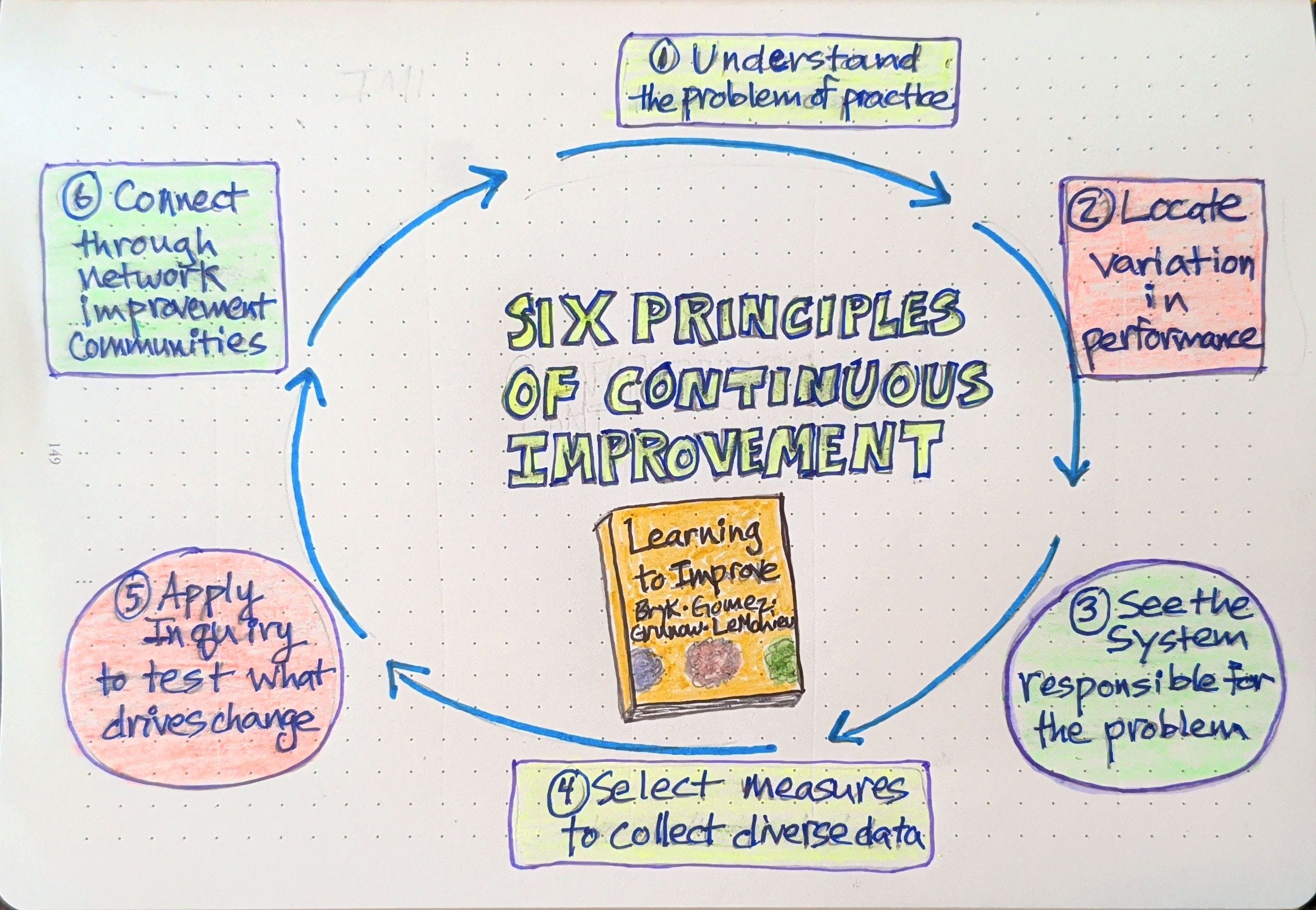
1. Understand the problem of practice that needs to be solved by collaborating with those affected by the problem.
When we heard that the teacher was “sold” on the program, we asked the team: “If this program is the solution, what is the problem it is solving?” The initial response was that they didn’t have a core program. We pressed them, asking what problem a core program would solve. They landed on improving their test scores. Their theory of action at the time was: If we implement a core ELA program, then students will receive more consistent and effective instruction.
2. Locate the variation in performance related to the problem to identify its root causes.
We accepted their response as a starting point. Then we disaggregated some of their assessment results. We wanted to see exactly which students were not succeeding as readers and writers. What we learned is that their students with disabilities and their students of color demonstrated lower achievement scores compared to all students. No one had a good response for what to do. To the team’s credit, they did not blame the students for these outcomes. They were willing to own the results.
3. See the system that is responsible for the problem.
To help the team take a step back, we mapped out more of their current system. We wanted to understand how different parts of the school experience were contributing to the outcomes they were seeing.
One challenge we discovered was the lack of any formal process for examining a new program, beyond trying it out in classrooms. In response, a curriculum implementation guide was used by the team to review the programs they were considering. Additionally, they formed a curriculum leadership team which described the roles and responsibilities of each member. Any decision on which program to recommend to the school board would go through a clear process with this team.
4. Select various practical measures to collect data on the implemented changes.
Beyond the process to support decision-making, the team also looked at demographic data. For example, their students’ attendance rates had not fully recovered to at least 95% since the pandemic. Chronic absenteeism was a particular issue for their students who scored in the bottom quartile of the state exam in reading. What additional data did the team need to learn?
Empathy interviews were recommended. Empathy interviews can “help us listen for how a person feels and perceives the equity challenge we are trying to address, as well as access their creative thinking around how to approach it” (Safir & Dugan, 2021, p. 177). I along with a teacher leader chatted with a dozen students about their current literacy experiences, including what they liked, what they didn’t, how they perceive themselves as readers and writers, and what they would like to see improve during ELA instruction.
Once we deidentified the data (interview transcripts), the teachers had a chance to read through them and write down themes and patterns.
5. Apply disciplined inquiry to test hypotheses about what drives change.
While collecting this qualitative data, teachers were also engaged in a pilot of their preferred resource. We co-created an assessment plan to help ensure that everyone was taking a more objective and comprehensive perspective of the resource.
We organized this assessment plan by three types of measures: outcomes, process, and balanced measures. Outcomes measures include traditional assessments such as end-of unit tests; process measures, such as the empathy interviews, provided data about the pilot as it was happening. A balance measure “comes from recognizing that when a change is introduced into one part of a complex work system, it often produces unintended changes elsewhere” (Bryk et al, 2015, p. 136).
The team anticipated a potentially unintended change:
If we introduce a core resource with fidelity, meaning to adopt it as prescribed by the publisher, what negative effects might there be on our students who currently struggle?
This question was driven in large part by the empathy interviews. Students who have historically not succeeded as readers and writers expressed what they needed: more hands-on, real world literacy tasks that had a meaningful impact in their lives. As the teachers explored the large student anthology text, they could see how parts of it might not be perceived by students as relevant.
6. Participate in networked improvement communities (NICs) of practitioners, content field experts, and researchers to collaboratively engage in the improvement process.
Instead of adopting, the ELA team decided to adapt the program during the implementation process. They would use various measures to monitor instruction during the school year, instead of assuming the program would simply work. There was also discussion around this team connecting with other area schools to learn from one another during implementation.
Improvement science tools fuel continuous improvement: many cycles of inquiry that support professional teams to examine their practices and make adjustments based on multiple measures including local data. They move from “loving a program” to loving the process.
References
Bryk, A. S., Gomez, L. M., Grunow, A., & LeMahieu, P. G. (2015). Learning to improve: How America’s schools can get better at getting better. Harvard Education Press.
DeMartino, S., Petrosky, A., & Nolly, G. (2026). A network for instructional improvement: How teachers and leaders made it work. Bloomsbury Publishing USA.
Safir, S., & Dugan, J. (2021). Street data: A next-generation model for equity, pedagogy, and school transformation. Corwin.
Enjoyed this article? Share it with a colleague, post online, and start a conversation in the comments!
Join me for a conversation with Jen Schwanke

Hi, it’s Matt. If you haven’t already, please provide feedback on Read by Example. Your insights and shared experience will help make this space even better for readers and literacy leaders. Thank you in advance!
Matt,
This sounds familiar. Adopt an already-made curriculum from publishers, then figure out what is wrong with it. That is like putting the cart before the horse.