
Teaching to the Text
On the difference between loving a book and teaching with one
👋 Hi, it’s Matt. Thanks for being a reader. I write about literacy and leadership, including my free guide, What School Leaders Need to Know About the Science of Reading. Last week, I shared about how easy it is to forget about the basics of coaching. This week, I differentiate between teaching to texts and through texts.
In a 2025 New York Times article, Dana Goldstein wonders whether “the age of the book may be fading.” The concern: kids rarely read entire books these days, averaging 1-2 per year, according to researchers and a survey this newspaper conducted. Potential root causes include social media and smartphones, scripted curricula, and pressure to perform well on state tests. Even Timothy Shanahan, noted literacy researcher, finds no reliable data supporting a positive correlation between reading whole books and reading achievement.
Before I question the debate itself, let me confess how I contributed to the problem.

In my early years as a 5th and 6th-grade teacher, my instruction was grounded in reading whole books. I integrated Hatchet1 within our social studies unit on Canada. The figurative language of Bridge to Terabithia was combined with a literal study of bridges within my math unit on geometry. I even had students create salt-dough landscapes from the novels to promote “visualization” as a reading strategy. (I was told by a colleague that “novel studies” is a calling card of 5th-grade teachers.)
This focus on novels has carried on for decades. As a principal, a teacher informed me that they “really teach Where the Red Fern Grows.” My pride would like me to say I had no idea what they were talking about. But I could imagine myself in their classroom, conjuring up activities that represent my excitement for the book without taking into account the interests and needs of my students.
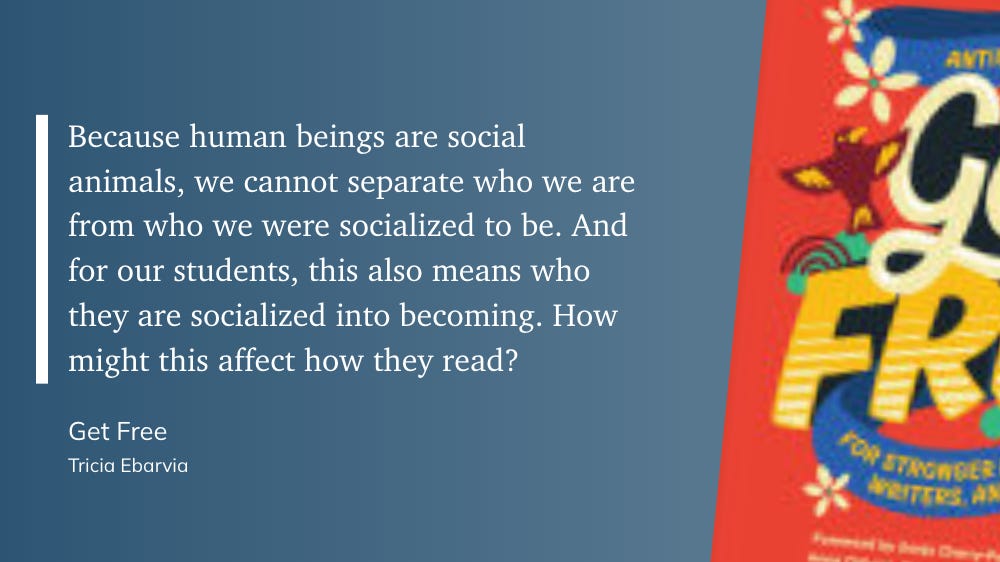
Tricia Ebarvia, veteran teacher and author of Get Free: Antibias Literacy Instruction for Stronger Readers, Writers, and Thinkers (Corwin, 2024), believes that we don’t teach a text. We teach text sets, tensions, and essential questions. We use texts to build students’ capacity to construct meaning and be more critically conscious thinkers. There is a difference between teaching to the text and teaching through text toward bigger ideas.
For example, Tricia initially taught Jane Eyre by Charlotte Brontë to her secondary students. She loved that story growing up, connecting with the main character’s resilience and independence. But when she encountered Jean Rhys’s Wide Sargasso Sea, Tricia found a counter-narrative that could lift a marginalized voice from Brontë’s classic. Bertha Mason, the “madwoman in the attic” in Jane Eyre, is Antoinette Cosway, a young woman who is sold into marriage to the prideful Mr. Rochester. Themes of colonialism, patriarchy, and systemic oppression are illuminated.
Ebarvia’s example is the destination. Where might we begin? It’s tempting to start by simply persuading teachers to incorporate counter-narratives with current novels. For instance, Where the Red Fern Grows can be paired with the Indigenous picture book When We Were Alone to enrich the themes of loss and love, while also creating tension around rural life, landscapes, and ownership. The Last Cuentista by Donna Barba Higuera, read alongside Hatchet, can expand upon the survival genre through essential questions and student discussion, such as “What does it mean to survive, and what are we surviving for?”
It starts with modeling. I recently demonstrated this at the Illinois Reading Council Conference.
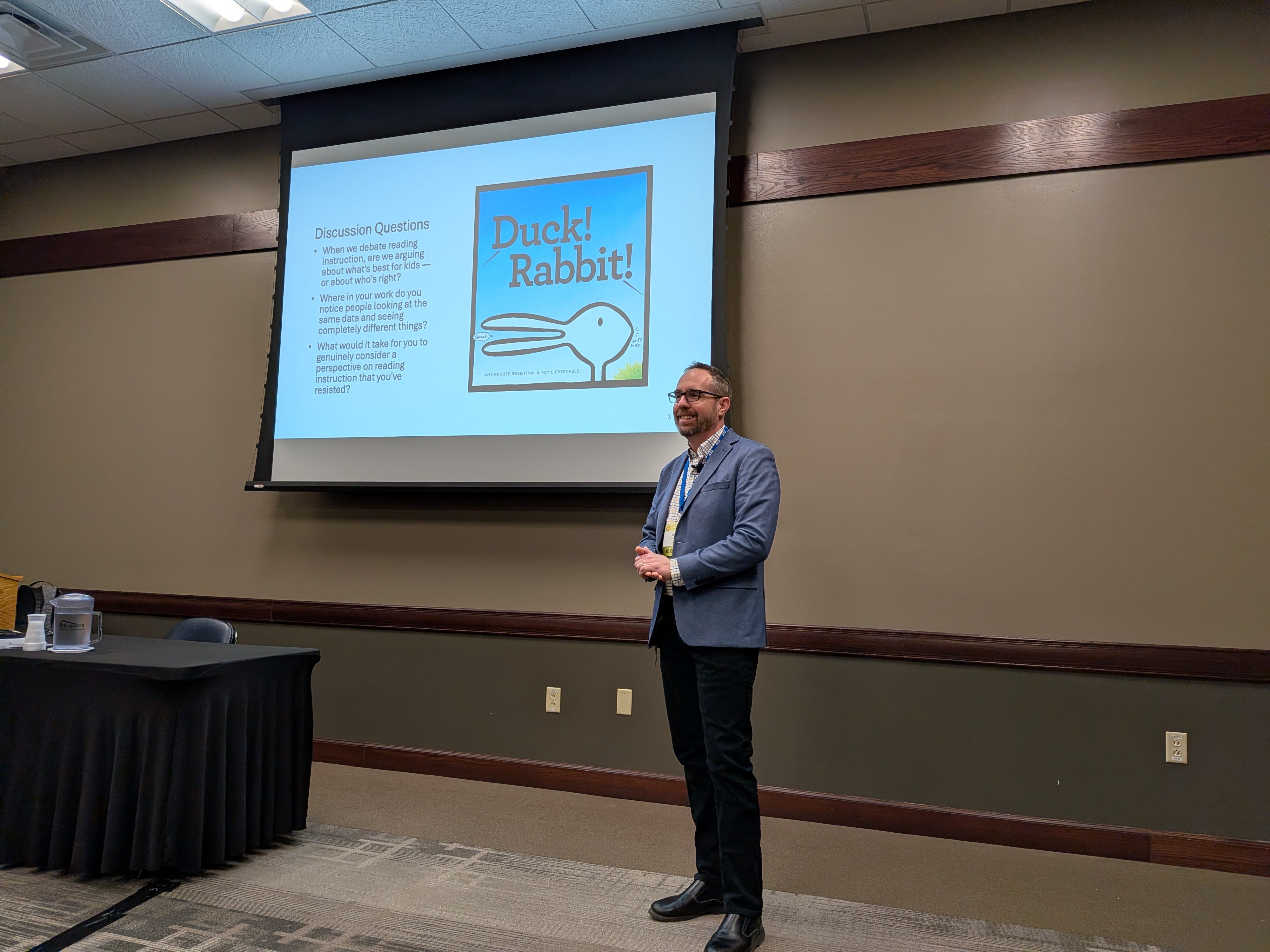
I started my session on what school leaders need to know about the science of reading by reading aloud a picture book: Duck! Rabbit! by Amy Krouse Rosenthal and Tom Lichtenheld. This smart, simple story uses an optical illusion to surface the tension related to different perspectives around effective reading instruction. After the read aloud, I invited small groups to discuss at least one of the following questions:
When we debate reading instruction, are we arguing about what’s best for kids — or about who’s right?
Where in your work do you notice people looking at the same data and seeing completely different things?
What would it take for you to genuinely consider a perspective on reading instruction that you’ve resisted?
Then I recommended a transition to a professional article on the subject, for example, Rachael Gabriel’s The Sciences of Reading Instruction. The humor of Duck! Rabbit! can help lower the temperature that this topic sometimes induces.
Besides building a shared understanding around the science of reading, a paired reading like this during professional learning serves as a model for expanding our instruction beyond any one text. The discussion questions emerge from the text and create an opening for dialogue rather than confirming our biases.
What if we stopped debating about whole books versus excerpts, and started asking whether the texts we choose are expanding our students’ identities and abilities as readers?
What’s one text you currently use or did use that could be paired with a counter-narrative? What tension might that pairing surface for students?
What I’m Reading: Bottlenecks in Education
Isobel Stevenson connects the recent closure of the Strait of Hormuz with the theory of constraints. She makes the point that “you can make improvements in all kinds of places in the system, but if you are not addressing a bottleneck—the one place in the system that is holding back the rest of the system—then you are not improving the system overall.” It got me thinking how just about anything in education, even books, can become a barrier to student learning if we are not intentional in our instruction.

Quotable
Many of the embedded links for books go to Bookshop.org, an affiliate account. Purchases there support this space and independent bookstores.